
Overview
Why Djanet is the gateway
Djanet is an oasis town in Algeria's far southeast, and almost every trip into the country's most famous desert starts there: it is where the domestic flights land, and where agencies assemble their crews — driver-guides, cooks, and the specialists who know the rock art sites. From town, two very different circuits open up: the Tadrart Rouge by vehicle, and the Tassili n'Ajjer plateau on foot.
Between them, this region concentrates the images most people associate with the Algerian Sahara: red dunes against sandstone cliffs, natural arches, and painted panels left by communities who lived here when the desert was a green savanna.
The classic
The Tadrart Rouge expedition
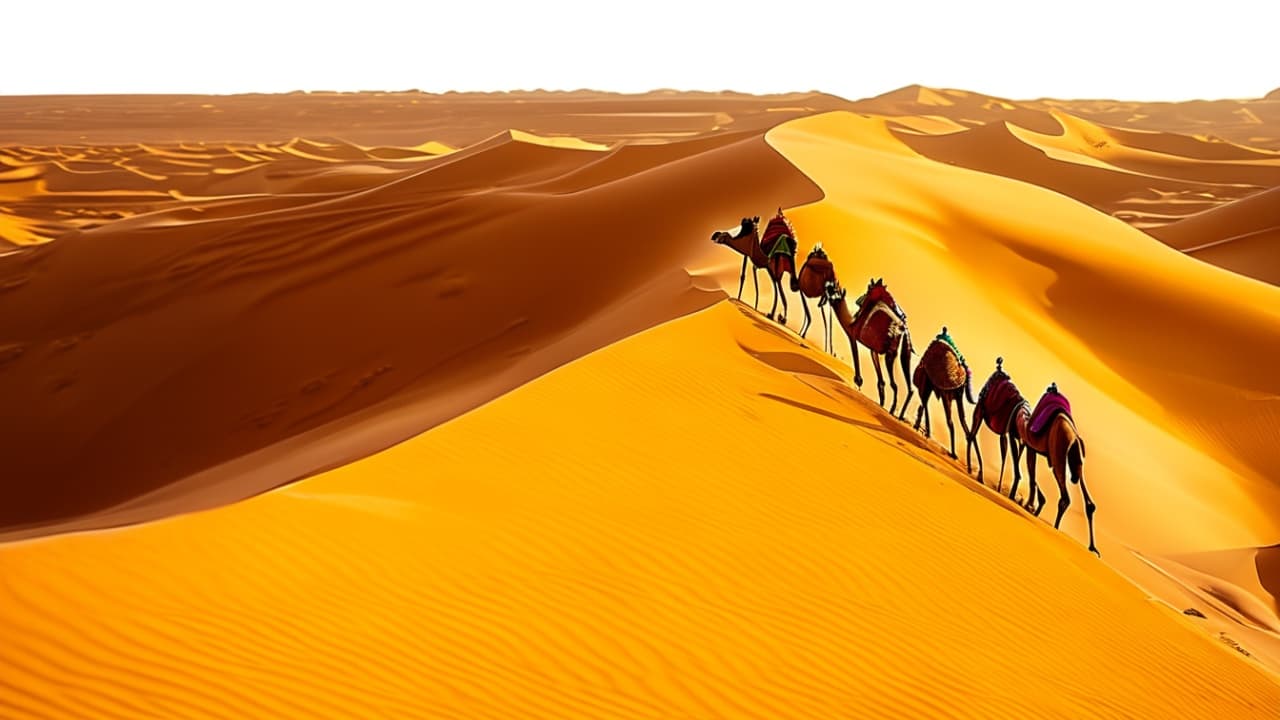
Count several hours of desert track southeast of Djanet to reach the first dunes of the Tadrart Rouge. The massif belongs to the same protected cultural park as the Tassili plateau, but the landscape is different: red-orange sand spreads at the foot of sandstone cliffs eroded into towers and buttresses — local guides sometimes call them cathedrals — with natural arches punched through some walls, and dry riverbeds lined with acacias winding between the dunes. At sunrise and sunset, when low light saturates the colors, it is the most photographed scenery in the Algerian Sahara.
The Tadrart keeps its own rock art too: engravings and paintings several millennia old showing giraffes, elephants, and antelope — animals long gone from the region — alongside scenes of pastoral life. Guides know where the sites are and in what order to visit them, within the park's protection rules.
The format: seven to eight days from Djanet, with one or more 4x4s carrying luggage, water, and camp equipment between sectors, and a full local team on board. Nights are spent in bivouac, under tent or open sky, around a campfire. The vehicles do most of the work — walks are limited to short outings, a dune climbed for sunset, or rock art sites reached on foot — so the circuit suits couples, friends, and families with teenagers, not just trekkers.
The honest part: comfort stays rustic. No hot shower every evening, basic sanitation, sleeping mats on the ground, several-hour stretches of track, and no mobile network from the moment you leave Djanet until you return. In exchange, you sleep under a sky with zero light pollution, in a silence that marks people as much as the landscape does.
The other classic
The Tassili plateau on foot
The other flagship trip from Djanet is the opposite format: a guided trek onto the Tassili n'Ajjer plateau, four to seven days on foot. There is no road onto the plateau at all — a full day's walk up the akba escarpment, then several days moving between painted sites with pack donkeys carrying water and supplies, past the eroded rock mazes of Sefar and the monumental Grand Dieu panel. It calls for decent fitness: several hours of walking per day over rocky terrain.
Almost nobody visits one without the other. Most agencies sell combinations — a few days on the plateau, then the descent to the Tadrart's dunes by vehicle — and the two massifs genuinely complement each other. Our Tassili n'Ajjer guide covers the plateau, its rock art, and the trek in detail.
Culture
The Sebiba festival
Djanet also hosts the Sebiba, an annual Tuareg festival of ritual dances and ceremonies recognized by UNESCO as intangible cultural heritage. One honest caveat for planners: it takes place in early summer — the 2026 edition ran in late June — which is the middle of the extreme-heat season, far outside the comfortable desert-circuit window. Treat it as a cultural trip in its own right, with the heat taken seriously, not as an add-on to a classic circuit.
Planning
When to go
Best
March-April, October-November
Good
Rest of October-April
Avoid
June-September, 30-42°C
Daytime heat stays real even in winter, while desert nights turn genuinely cold. And one date to anticipate: spending New Year's Eve in a Tadrart bivouac has become a season classic — domestic flights and agency slots fill up weeks in advance, so book from autumn if you are targeting those dates. October-November and March-April offer the same conditions with fewer people.
Planning
How to get there
International arrival is almost always through Algiers, followed by a domestic flight — Air Algérie or Tassili Airlines — to Djanet, around two hours and fifteen minutes. Driving down from the north is not a realistic option, and there is no scheduled Paris-Djanet route: occasional charters appear, but should not be planned around. Seasonal frequencies on the Algiers-Djanet route are worth confirming with your agency before locking the rest of your dates.
Algeria is a cash-first country: the dinar is not convertible abroad, foreign cards are accepted in few places, and circuits are typically settled by bank transfer or cash after a written quote — there is no standard online checkout with Algerian agencies.
Before you book
The agency rule and the visa
In the deep Sahara, going through a licensed Algerian agency is mandatory, and the authorities validate itineraries before departure. You are not booking a room and improvising from there: you book a complete program, from the airport transfer in Djanet to the last bivouac, with the crew, permits, and route handled by the agency.
For foreign visitors, the same organized circuit unlocks Algeria's visa on arrival: the agency files your application, generally about fifteen days before departure, for a visa covering a 30-day stay. Without an agency there is no visa on arrival — and without a visa, no access to the protected areas of the south.
This is where Dalil fits in: we list Algerian agencies from public information and act only as the introduction between you and them — never as the tour operator. Ask the agency for its Ministry of Tourism licence number before you pay.
Safety
Is Djanet safe?
The US State Department rates Algeria Level 2 overall — 'Exercise Increased Caution' — with its stricter Level 4 warning limited to areas within roughly 250 km of the borders with Libya, Niger, and Mali. Djanet, the Tadrart, and the Tassili sit well outside those border zones and are visited on licensed, guided circuits with government-validated itineraries — the supervision is part of how the trip stays safe, not a formality. Our full safety guide covers the country picture, zone by zone.
Budget
Costs
Multi-day circuits in the Algerian Sahara observed on the market run roughly €120-250 per person per day, covering guiding, 4x4 transport or pack animals, food, and camping equipment. The total depends on trip length, group size, and camp comfort level — an eight-day Tadrart expedition with a full crew costs more per day than a shorter, simpler format.
This is a market range, not a Dalil price: always get a written, itemized quote from a licensed agency before booking anything.
Agencies
Travel agencies in the region
The agencies listed for this part of the Sahara have their own pages.
Keep exploring
Related guides
FAQ
Frequently asked questions
How many days do you need for a Djanet tour?
The classic Tadrart Rouge expedition runs seven to eight days from Djanet, transfers included, often with a few days on the Tassili plateau before the descent to the dunes. Guided treks into the Sefar area of the plateau alone run four to seven days on foot. Shorter formats exist, but they leave less time to explore the different sectors.
Do you need to be fit for a Djanet circuit?
It depends on the circuit. The Tadrart is covered almost entirely by 4x4: walks are limited to short outings around viewpoints, a dune climb for sunset, or access to rock art sites — no particular fitness required beyond tolerating heat and long days outdoors. The Tassili plateau trek is the opposite: a walking trip with several hours on foot each day over rocky terrain.
How do you get to Djanet?
Almost all foreign visitors arrive internationally through Algiers, then take a domestic flight — Air Algérie or Tassili Airlines — to Djanet, around two hours and fifteen minutes. Driving down from the north is not a realistic option, and there is no scheduled Paris-Djanet route: only occasional charters. Seasonal flight frequencies are worth confirming with an agency.
Can you explore the desert around Djanet without an agency?
No. France's foreign ministry states plainly that independent travel without a guide is not possible in the Algerian Sahara. The Tadrart and the Tassili sit inside a protected cultural park, itineraries are validated by the authorities before departure, and the visa on arrival used by most foreign visitors only exists through a licensed agency's application.
When is the best time to visit Djanet?
October to April, with the most comfortable weeks in October-November and March-April. June to September brings 30-42°C daytime heat, and agencies stop running circuits. New Year's Eve in the Tadrart has become the most requested week of the season — flights and agency slots fill up weeks ahead, so book from autumn if you are aiming for it.
What is the Sebiba festival?
An annual Tuareg festival held in Djanet and recognized by UNESCO as intangible cultural heritage: ritual dances and ceremonies that draw visitors specifically for the event. Honest warning — the 2026 edition ran in late June, in the middle of the extreme-heat season, far outside the comfortable desert-circuit window. It is a cultural trip, not a classic desert expedition.
Last verified: 25 August 2026
Practical details such as visa costs and entry requirements can change — we review this page regularly to keep it accurate.