
Overview
Six regions, six very different deserts
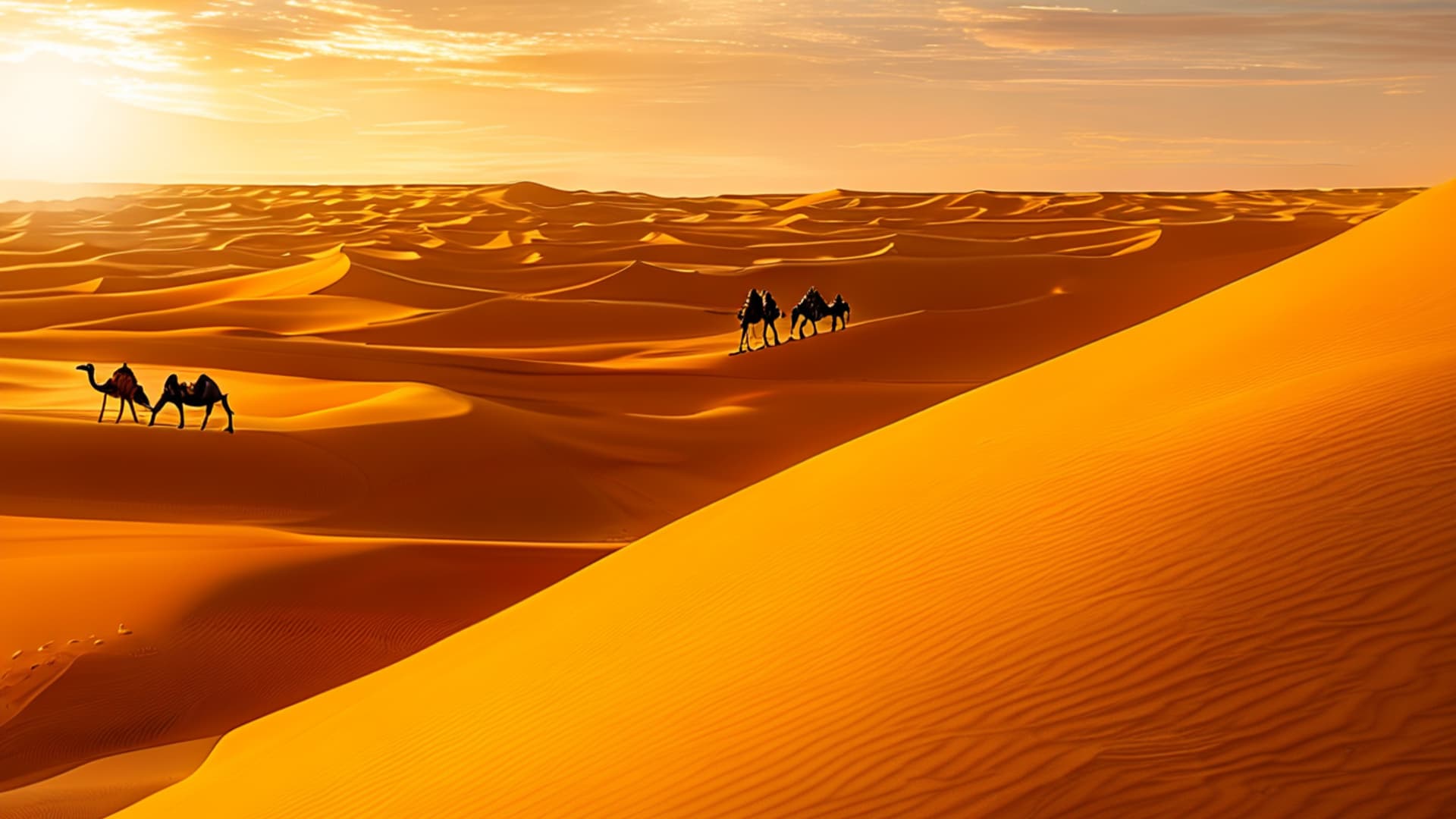
The Algerian Sahara is not one landscape. Djanet and its surroundings hold the red dunes and rock art the country is famous for; the Hoggar is volcanic and mineral; Taghit sits on the edge of a sea of sand you can reach without an expedition; Timimoun and Ghardaïa are built heritage as much as desert. Choosing a tour starts with choosing the right region — the dates, the budget, and the fitness level all follow from that first decision.
This page maps the six regions Algerian agencies actually sell, explains the three rules that shape every Sahara trip here, and gives the honest cost and season picture. Each fact was last checked on the date shown at the bottom of the page.
The ground rules
How Sahara travel works in Algeria
You travel with a licensed agency.For the deep desert — Djanet, the Tassili, the Tadrart, the Hoggar — this is not a recommendation but the rule: France's foreign ministry states plainly that independent travel without a guide is not possible in the Algerian Sahara. Itineraries are validated by the authorities before departure, and some routes are escorted. In practice you book a complete program, from airport pickup to the last bivouac.
The visa follows the tour.Since 2023, foreign visitors on an organized southern circuit can use Algeria's visa on arrival: the agency files the application before departure, and the visa is issued at the airport. Our guide to the Sahara visa on arrival covers eligibility, steps, and cost.
Booking is quote-based, not checkout-based. Algeria is a cash-first country: the dinar is not convertible abroad, foreign cards are accepted in few places, and there is no standard online booking with Algerian agencies. A circuit is settled by bank transfer or cash after a written quote — which is exactly why comparing agencies before you commit matters.
The regions
Where Sahara tours actually go
Djanet, the Tassili n'Ajjer and the Tadrart Rouge — the major expedition
Red dunes, natural sandstone arches, and the UNESCO-listed rock art of the Tassili n'Ajjer: this far-southeast region concentrates the images most people associate with the Algerian Sahara. The classic format combines the Tadrart by 4x4 with time on the Tassili plateau on foot, seven to eight days in bivouac, reached by a 2h15 domestic flight from Algiers. Several days without mobile network and rustic camp comfort make it a trip for committed desert travelers. Start with our guides to Djanet and the Tassili n'Ajjer.
Tamanrasset, the Hoggar and the Assekrem — the mineral desert
No sea of dunes here: volcanic mountains, black basalt peaks, and the sunrise from the Assekrem, one of the best-known viewpoints in the Sahara. Circuits mix trekking and 4x4 over five to six days, slightly shorter than the Djanet loop, with nights in bivouac or mountain shelters. Reached by a roughly 2h30 flight from Algiers. For travelers who prefer walking and mineral landscapes — and who do not fear the cold: winter nights at altitude drop below freezing.
Taghit and Béni Abbès — the accessible Sahara
In the southwest, the dunes of the Grand Erg Occidental meet adobe ksour and palm groves — with a hotel bed every night and day excursions instead of mandatory bivouac. Two to four days cover one town; a week combines both. Access is via Béchar, connected to Algiers by air, road, and rail. The most forgiving entry point into the Algerian desert: less logistics, fewer days, lower cost — well suited to first trips and families.
Timimoun and the Gourara — the oasis at a gentle pace
Timimoun is about architecture more than dunes: ochre adobe inspired by Sahel cities, ksour scattered through the palm grove, foggaras — the underground channels that water the gardens without pumps — and a salt lake for the end of the day. Two to three days, no bivouac, no trek, reached by domestic flight from Algiers or by road from the southwest. For travelers who want culture and calm rather than physical effort.
Ghardaïa and the M'Zab valley — the Saharan weekend
Five fortified towns forming a UNESCO-listed architectural ensemble, at human scale and with nothing to organize beyond transport and a room. This is the Saharan region closest to Algiers by road, workable as a simple weekend: two days cover the ksour and the market. A good first taste of the south before committing to a longer circuit.
El Oued and the Souf — a thousand domes on the Grand Erg Oriental
A domed architecture found nowhere else in Algeria, and real dunes minutes from the town center — without the hours of desert track needed to reach Djanet or Tamanrasset. Two to three days cover the town, the ghouts (sunken palm gardens dug into the sand), and a dune excursion. A practical way to see the Grand Erg Oriental, or a second stop after Ghardaïa.
Agencies
Travel agencies in the region
Each wilaya has its own page listing the agencies we found in public sources.
Choosing
Which region fits your trip
- First Sahara trip: Taghit, Béni Abbès, Timimoun, or Ghardaïa — solid accommodation every night, short formats. Save Djanet and the Hoggar for the next one.
- Traveling with children: the same regions — day excursions rather than multi-day treks.
- Tight budget or tight schedule: a Ghardaïa weekend costs a fraction of an eight-day 4x4 expedition in the Tadrart.
- Eight to ten days available: that is expedition territory — Djanet with the Tassili and Tadrart, or the Hoggar.
- Photography first: red dunes and arches in the Tadrart, mineral sunrise at the Assekrem, white domes in El Oued, ochre adobe in Timimoun.
Season
When to go
Best
March-April, October-November
Good
Rest of October-April
Avoid
June-September, 30-42°C
The calendar matters as much as the destination: no serious agency runs desert circuits through the summer heat. One planning note — New Year's Eve in the desert is the most requested week of the season, and both domestic flights and agency slots fill up weeks in advance. If you are aiming for it, book in autumn.
Budget
What a tour costs
Multi-day organized circuits observed on the market run roughly €120-250 per person per day: guiding, 4x4 transport or pack animals, food, and camping equipment included. The total moves with group size, season, and length — and the gentler regions (Ghardaïa, Timimoun, Taghit) sit well below expedition pricing, since there is no camp crew to mobilize.
This is a market range, not a Dalil price: always ask a licensed agency for a written, itemized quote before booking anything.
Next step
Get quotes from Algerian agencies
Tell us which region draws you — or let the agencies suggest one for your dates and group. Dalil lists Algerian agencies from public information and passes your request to one to three of them. Ask the agency for its Ministry of Tourism licence number before you pay. We are the introduction, never the tour operator.
Keep exploring
Related guides
FAQ
Frequently asked questions
Can you visit the Algerian Sahara without an agency?
Not in the deep desert. France's foreign ministry states plainly that independent travel without a guide is not possible in the Algerian Sahara: itineraries are validated by the authorities before departure, and some routes are escorted. For the gentler regions — Ghardaïa, Timimoun, El Oued — an agency is not imposed, but it remains the simplest way to arrange transport and accommodation.
How much does a Sahara tour in Algeria cost?
Multi-day organized circuits observed on the market run roughly €120-250 per person per day, covering guiding, 4x4 transport or pack animals, food, and camping equipment. The total moves with group size, season, and trip length — a weekend in Ghardaïa costs far less than an eight-day Tadrart expedition. Always get a written, itemized quote from a licensed agency.
When is the best time for a Sahara tour?
October to April, with the most comfortable weeks in October-November and March-April. From June to September, daytime temperatures reach 30-42°C and serious agencies stop running circuits. New Year's Eve in the desert is the most requested week of the season: domestic flights and agency slots fill up weeks in advance.
Which region is best for a first Sahara trip?
Taghit and Béni Abbès, Timimoun, or Ghardaïa: real dunes or remarkable architecture, a hotel bed every night, and formats of two to four days without mandatory bivouac. The full expeditions — Djanet, the Tassili, the Tadrart, the Hoggar — reward a second trip, once you know you like desert travel.
How do you get to the Algerian Sahara?
International arrival is almost always through Algiers, then a domestic flight south: around 2h15 to Djanet, around 2h30 to Tamanrasset, both with Air Algérie or Tassili Airlines. Taghit and Béni Abbès are reached via Béchar (air, road, or rail from Algiers), and Ghardaïa is the closest Saharan region to Algiers by road.
Do foreign visitors need a visa for a Sahara tour?
Most nationalities do, and organized Sahara circuits open the simplest route: a visa on arrival, available since 2023 for tours booked through a licensed Algerian agency and running mostly through the southern wilayas. The agency files the application before departure. Trips centered on the northern cities fall under the standard consular visa instead.
Last verified: 25 August 2026
Practical details such as visa costs and entry requirements can change — we review this page regularly to keep it accurate.