
Overview
What the Tassili n'Ajjer is
The Tassili n'Ajjer is a sandstone plateau in the far south of Algeria, above the town of Djanet. It is one of seven UNESCO World Heritage Sites in Algeria, and the only one with a double listing, both cultural and natural, inscribed in 1982. The plateau holds one of the largest concentrations of prehistoric rock art anywhere in the world: engravings and paintings spread across thousands of sites, spanning several millennia, from Neolithic hunters to later pastoralist and camel-herding communities.
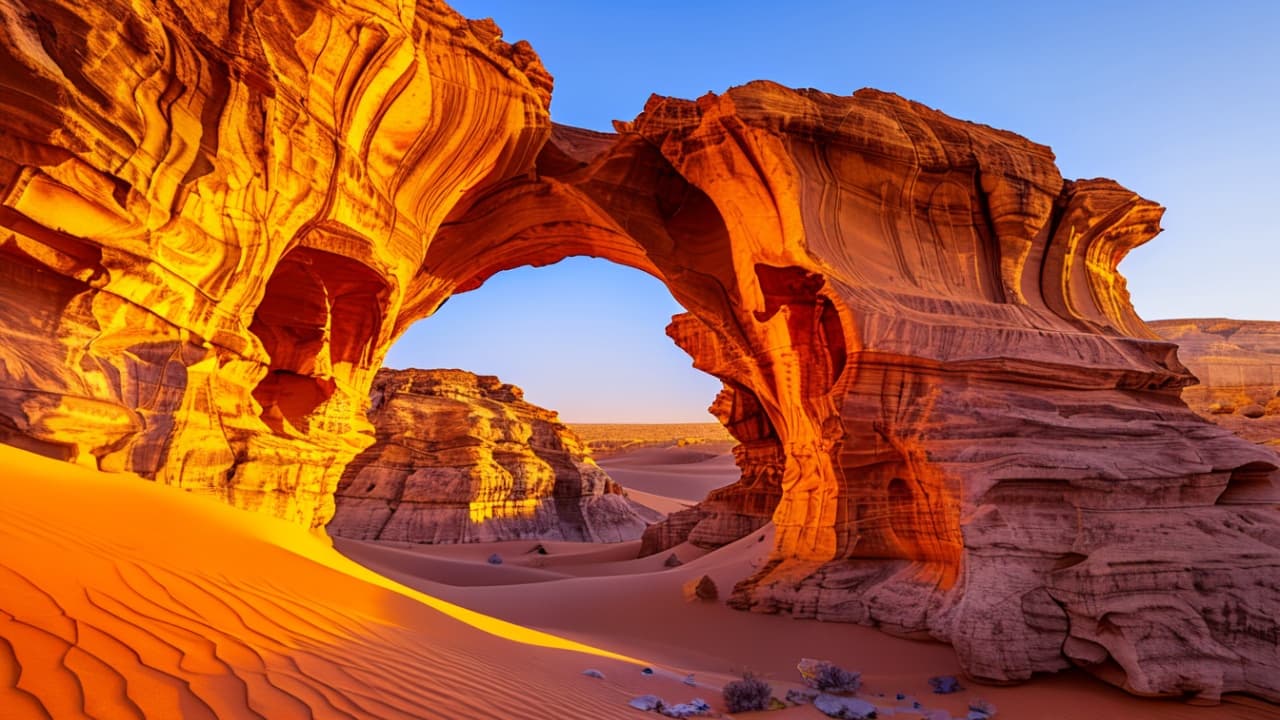
Some of the painted scenes show animals that no longer live anywhere near the region: giraffes, hippopotamuses, elephants, evidence that this part of the Sahara was once a far greener landscape, crossed by rivers and lakes. The plateau's geology is worth the trip on its own terms: wind- and water-eroded sandstone formations, natural arches, and a relict Saharan cypress species that grows nowhere else on Earth.
On the plateau
What you actually see there
Most guided routes on the plateau pass through the Sefar area, one of the richest concentrations of rock paintings in the whole Tassili. Seen from below, Sefar looks almost like the ruins of a city: corridors, rock towers, and open spaces cut by millions of years of erosion, not by human hands. No trace of any built structure has ever been found there.
What is genuinely man-made covers the rock walls instead: hundreds of painted panels, including the Grand Dieu de Sefar, a monumental human figure several meters tall surrounded by smaller figures and one of the best-known images in Saharan rock art. It belongs to the 'Round Heads' style, one of the oldest painting periods on the plateau, and most researchers read it as a ritual or symbolic scene rather than a literal portrait. Around it, other panels show cattle herds, antelope, and mouflon, a record of daily life from a much wetter Sahara, painted by the same Neolithic communities who sheltered under these rocks.
Sefar has also picked up a reputation online as a 'lost city', a reading that goes back partly to 1950s expedition accounts and the pop-science retellings that followed. Archaeological research has not found any trace of urban construction: the corridors and towers are geology, not architecture, and the Round Heads paintings are generally read as ritual or symbolic imagery, not portraits of anything stranger. The real experience does not need embellishing, walking through a natural sandstone maze carved over millions of years, past paintings made by people living in a Sahara that looked nothing like it does today, is enough on its own.
The paintings are also fragile. Never touch a painted wall: skin oils degrade the pigments over time. Never wet a panel to bring out the colors for a photo either, a practice that has already damaged entire frescoes elsewhere on the plateau. Nothing should be collected: Tassili n'Ajjer is a protected cultural park, and its guides are trained to enforce these rules on every trek.
Planning
When to go
Best
March-April, October-November
Good
Rest of October-April
Avoid
June-September, 30-42°C
The plateau adds its own twist in winter: nights get genuinely cold at altitude, with occasional frost possible in December and January, so a proper sleeping bag is not optional. There is no mobile network or electricity anywhere on the plateau for the length of a trek.
Planning
How to get there
International arrival is almost always through Algiers. From there, a domestic flight, Air Algerie or Tassili Airlines, connects to Djanet in around two hours and fifteen minutes. There is no scheduled Paris-Djanet route: charter flights appear occasionally, but shouldn't be treated as a fixed option, and seasonal frequencies on the Algiers-Djanet route are worth confirming directly with an agency before you plan the rest of your trip around them.
Algeria is a cash-first country with a non-convertible dinar; foreign cards are accepted in few places, and desert circuits are typically settled by bank transfer or cash after a written quote, not through an online booking system.
Before you book
You need a licensed agency
This is the fact that shapes everything else about planning a Tassili trip: France Diplomatie, the French foreign ministry, states plainly that it is not possible to travel without a guide in the Algerian Sahara. Every itinerary is validated by the local authorities before departure, and some routes are escorted.
On the Tassili plateau itself, the rule is even more literal than elsewhere in the Algerian Sahara. There is no road onto the plateau at all, so even circuits that use 4x4 vehicles nearby, in the Tadrart Rouge, for instance, leave their vehicles behind here. The Sefar loop is walked, with pack donkeys carrying water, food, and camping gear, organized by a licensed Algerian agency alongside the guides and permits. Walking it calls for decent physical fitness too: several hours on foot each day over rocky terrain, with no option to turn back partway once a stage is underway.
This is also where Dalil fits in. We list licensed Algerian agencies and act only as an introduction service between travelers and agencies, never as the tour operator ourselves. Foreign visitors booking a Sahara circuit typically go through Algeria's visa-on-arrival scheme, with the paperwork filed by the agency ahead of your trip: see our guide to Algeria's visa on arrival for the Sahara for the full process.
Safety
Is it safe?
The US State Department rates Algeria Level 2 overall, 'Exercise Increased Caution', with the stricter Level 4 warning limited to areas within roughly 250 km of the borders with Libya, Niger, and Mali. UK government advice broadly agrees with that picture.
Djanet and the Tassili n'Ajjer sit well outside those border zones and are visited on licensed, guided circuits. None of this should be read as a reason to dismiss the risk, or to dramatize it: it is precisely why a licensed agency with a government-validated itinerary isn't a bureaucratic formality here, it's part of how the trip stays safe. Algerian authorities sometimes add an escort to tourist convoys in the south as part of that same validated-itinerary system, which is a routine precaution rather than a sign of particular danger on the route you would actually be taking.
Budget
Costs
Multi-day desert circuits in the Algerian Sahara, guided treks like the Sefar loop included, tend to run in the range of €120-250 per person per day, based on prices observed on the market. That range covers guiding, pack animals or 4x4 transport, food, and camping equipment, and it varies with group size and season. Expect the total to move with trek length and difficulty too: a longer Sefar loop with extra rest days costs proportionally more per person than a shorter itinerary covering fewer sites.
This is a market range, not a Dalil price: always get a written, itemized quote from a licensed agency before booking anything.
Agencies
Travel agencies in the region
The agencies listed for the Tassili n'Ajjer wilayas have their own pages.
Keep exploring
Related guides
FAQ
Frequently asked questions
What can you see at Tassili n'Ajjer?
The plateau holds thousands of prehistoric rock art sites. Around Djanet, the Sefar area is one of the richest: eroded sandstone formations that look almost architectural, and painted panels including the Grand Dieu de Sefar, a monumental figure from the ancient 'Round Heads' style. Other panels show cattle, antelope, and mouflon from a time when the Sahara here was a green, inhabited savanna. The plateau's geology alone, natural arches, wind-carved rock towers, a relict Saharan cypress found nowhere else, is worth the trip on its own.
How many days should I plan for a visit?
Most guided treks into the Sefar area run four to seven days from Djanet: a full day's walk up the akba escarpment onto the plateau, several days moving between painted sites with pack donkeys carrying water and supplies, then the descent. It's a walking trip, vehicles stay below on the plain.
When is the best time to visit?
October to April is the usable season, with March-April and October-November the most comfortable weeks. Avoid June to September: daytime temperatures on the plateau climb to 30-42°C, and no agency runs serious circuits in that window.
How do you get to Djanet?
Almost all foreign visitors arrive internationally through Algiers, then take a domestic flight, Air Algerie or Tassili Airlines, to Djanet, around two hours and fifteen minutes. There is no scheduled Paris-Djanet route; occasional charters exist but should not be relied on, and seasonal frequencies are worth confirming directly with an agency.
Can you visit without an agency?
No. France Diplomatie states plainly that independent travel without a guide is not possible in the Algerian Sahara. Every itinerary is validated by the local authorities before departure, and on the Tassili plateau itself there is no road at all: the Sefar loop is walked, with a licensed Algerian agency organizing guides, permits, and pack animals.
Is Tassili n'Ajjer safe to visit?
The US State Department rates Algeria Level 2 overall ('Exercise Increased Caution'), with the stricter Level 4 warning limited to areas within about 250 km of the borders with Libya, Niger, and Mali. Djanet and the Tassili n'Ajjer sit well outside those border zones and are visited on licensed, guided circuits, the same agency requirement that applies across the Algerian Sahara.
Last verified: 24 August 2026
Practical details such as visa costs and entry requirements can change — we review this page regularly to keep it accurate.